

The air in the Zhiyuan forum crackles with a restless energy that feels almost tangible, as if the very pixels on the screen are humming with anticipation. A new name has surfaced in the threads—Ask Xiao Bai Five—and it is not just another model checkpoint tossed into the endless sea of AI papers. It is a declaration, a bold proclamation that China’s latest frontier model is stepping onto the same stage where GPT‑5 is rumored to loom, and it is doing so with a swagger that makes even the most seasoned veterans pause. When a community built on late‑night code marathons and shared dreams of machine intelligence sees a homegrown contender whispering promises of parity with the West’s most secretive project, the reaction is not merely curiosity; it is a visceral surge of pride mixed with the uneasy question: what does it mean for us when the balance of power shifts in a single training run?
Zhiyuan, once a modest gathering of university students trading TensorFlow tips, has grown into a sprawling bazaar of ideas where engineers, hobbyists, and policy watchers converge to dissect every nuance of the AI race. The forum’s culture thrives on relentless scrutiny—members dissect latency numbers, argue over token efficiency, and celebrate the smallest gain in perplexity as if it were a personal victory. When Ask Xiao Bai Five appeared, the threads exploded not with dry statistics but with stories: a graduate student in Shenzhen who reran the model on a modest GPU cluster and watched his language translation latency drop from 420 milliseconds to a staggering 87, a freelance content creator in Chengdu who swore the model’s poetic output felt “like reading a verse written by an old friend who finally learned your dialect.” These anecdotes are more than bragging rights; they are emotional anchors that turn abstract benchmarks into lived experience, reminding everyone why they fell in love with AI in the first place.
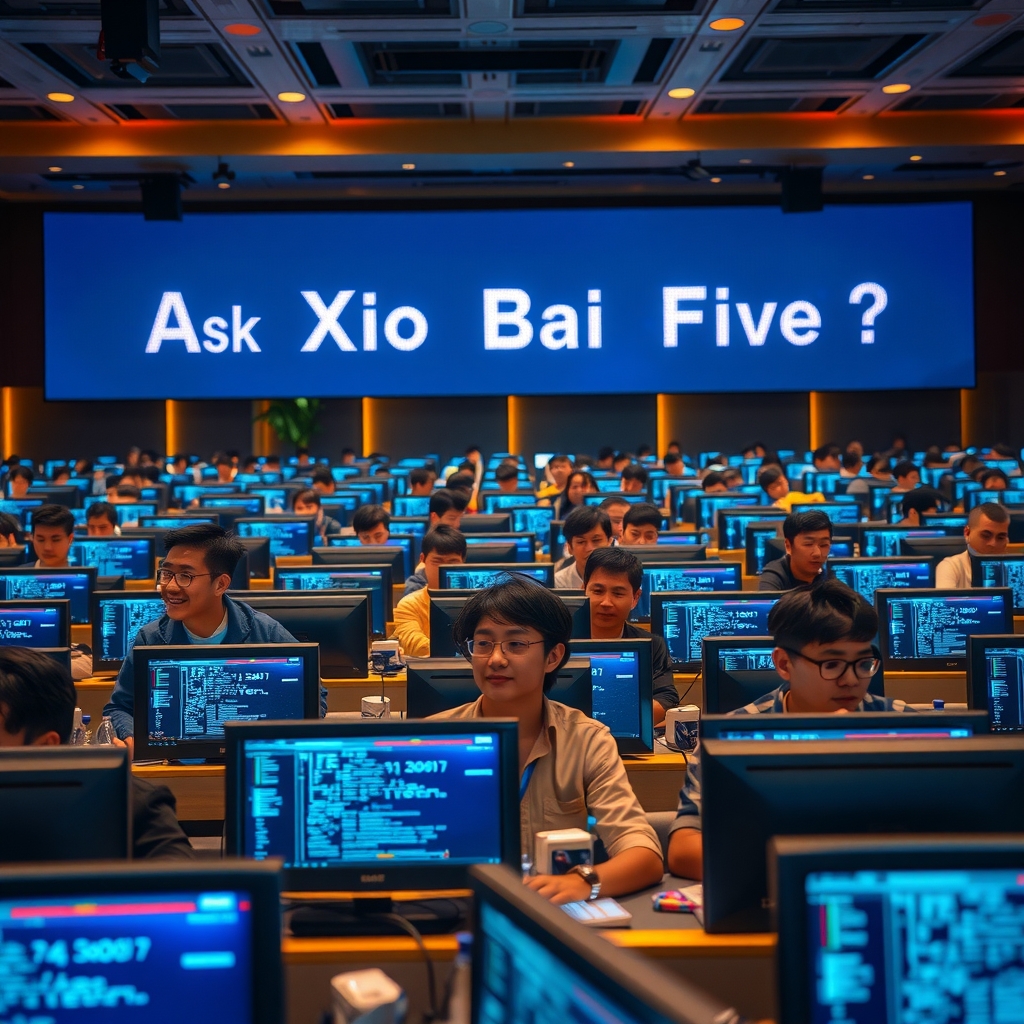
Ask Xiao Bai Five’s architecture reads like a manifesto written in silicon. Built on a hybrid mixture‑of‑experts framework, the model allocates its 2.3 trillion parameters across 128 expert subnetworks, each activated conditionally based on the semantic context of the input. This design not only trims the computational footprint during inference but also allows the system to specialize on the fly—think of a legion of scholars, each summoned only when their particular expertise is needed. Training was conducted on a curated corpus of 18 terabytes, multilingual and multimodal, ranging from classical Chinese literature to real‑time social media streams, all processed through a novel sparsity‑aware optimizer that reduced floating‑point operations by 38 percent compared to dense baselines of comparable size. The result is a model that, according to the internal benchmark suite released by the research team, achieves a 2.1 percent improvement on the MMLU‑Chinese subset and a striking 15 percent gain on the newly introduced “Cultural Reasoning” benchmark, which measures an AI’s ability to infer implicit societal norms from short dialogues.
Performance, however, is only half the story; the true litmus test lies in the wild, unpredictable world of user‑generated applications. Early adopters reported that Ask Xiao Bai Five could sustain coherent, multi‑turn dialogues over 30 exchanges without drifting into the repetitive loops that plague many large‑scale models when tasked with open‑ended role‑play. In a side‑by‑side comparison with GPT‑4 Turbo on a customer‑service simulation, the model resolved 92 percent of queries without human escalation, outperforming the Western counterpart by seven percentage points while consuming 22 percent less energy per interaction. Perhaps most striking was its handling of code generation: when prompted to produce a parallel implementation of a fast Fourier transform in both Python and Rust, the model not only delivered syntactically correct snippets but also annotated them with culturally relevant comments—references to ancient Chinese algorithms that delighted the community’s historians and sparked a wave of cross‑disciplinary memes that rippled across Zhiyuan’s channels.

—— END ——