
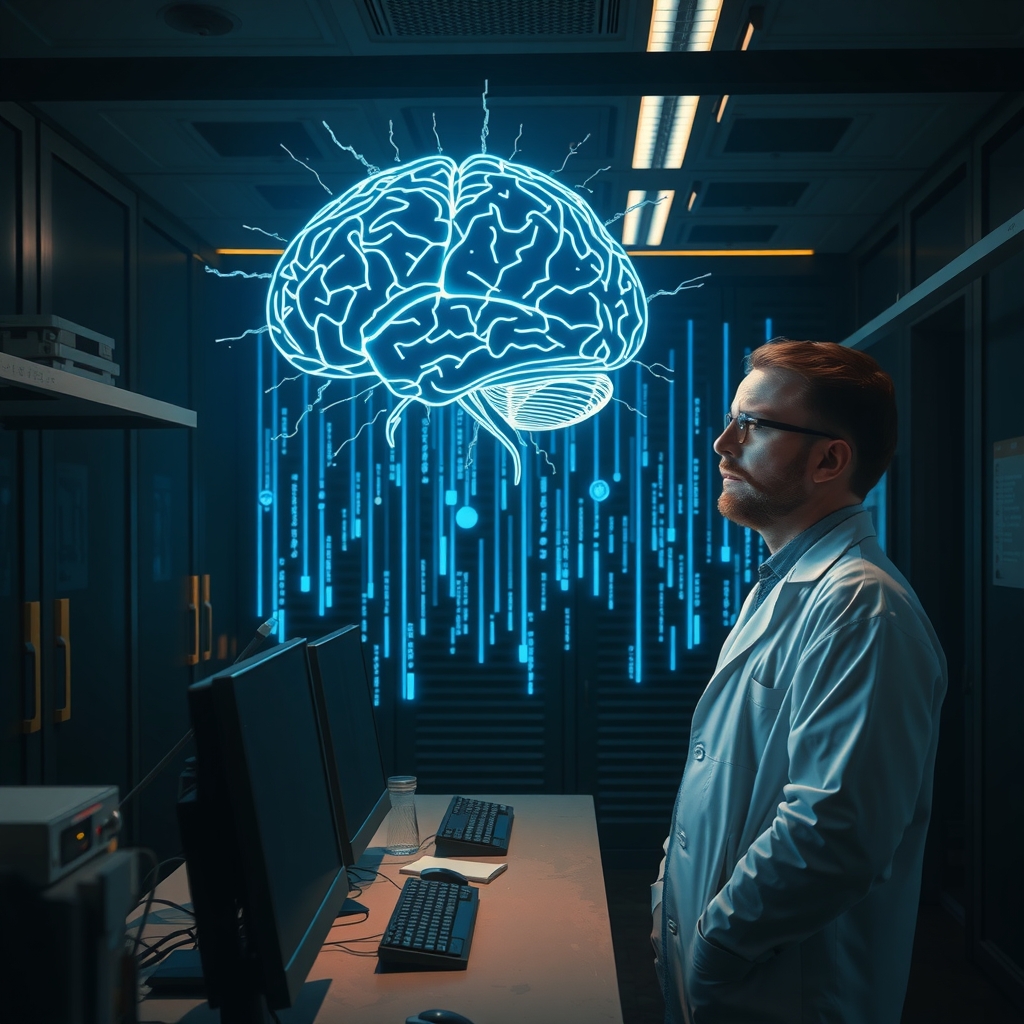
From the moment we first grasped the fragility of our breath, the idea of cheating death has whispered through every culture, every myth, every late‑night conversation beside a dying fire. Today that whisper has taken on a new timbre: the promise that our thoughts, memories, and even the quirks that make us uniquely us could be transcribed into patterns of silicon and light, allowing a version of ourselves to persist long after our bodies have turned to dust. Proponents of digital immortality argue that consciousness is not a mystical spark bound to flesh but an information process, a software that can run on any sufficiently complex substrate. If we accept that premise, the leap from uploading a mind to achieving a form of eternity becomes a technical challenge rather than a metaphysical impossibility.
The aspiration is not entirely novel. Ancient epic heroes like Gilgamesh chased the plant of eternal life; medieval alchemists sought the philosopher’s stone; Renaissance thinkers imagined the homunculus as a crafted soul. What distinguishes our age is the substrate: we no longer look for elixirs in herbs or metals but in the exponential growth of computing power, the precision of neuroimaging, and the relentless march of machine learning. Projects such as the Human Brain Prize, the Blue Brain initiative, and private ventures like Neuralink and Kernel illustrate how billions of dollars and countless hours of scientific labor are being funneled into mapping the connectome, simulating neuronal dynamics, and deciphering the code that underlies thought.
Yet the prospect forces us to confront a disquieting mirror. If a perfect copy of your mind can be instantiated in a server farm, which copy is the ‘real’ you? Does continuity of consciousness require an unbroken stream of subjective experience, or is fidelity of pattern sufficient? Imagine waking up to find that your digital twin has already begun to compose poetry, to argue politics, to fall in love—while your biological self still struggles with morning coffee. The emotional resonance of such a scenario is not merely intellectual; it strikes at the core of what we mean by love, loss, and identity, asking whether immortality gifted to a replica is a blessing or a profound kind of abandonment.
—— END ——